

The honest answer is that a properly fitted set of 4mm PVC rally style mudflaps should last the life of the car. Since PolyWard started making these products in 2019, there has not been a single instance of the mudflap material itself failing: no cracking, no UV degradation, no tearing from normal road use. The PVC holds up.
What occasionally needs attention is the hardware: the brackets, bolts, and fixings that mount the mudflaps to the arch liner. That’s a different question from how long the mudflaps last, and it has a different answer.
If you’re still researching what separates rally style mudflaps from universal panels and generic sets, see our guide to the difference between rally mudflaps and rally style mudflaps.

What actually causes rally style mudflaps to fail
The mudflap material is not the weak point. 4mm PVC is flexible, UV-stable, and resistant to the chemicals and conditions it encounters on a road car. It doesn’t crack in cold weather, fade significantly under UV exposure, or tear under normal road conditions. The only scenario where the material itself is likely to fail is a significant direct impact. Something like a kerb strike at speed, a road debris impact at the mounting hole, or a car park incident. Even then, a 4mm thick PVC mudflap is more likely to flex and recover than to crack or tear.
The hardware is the component that needs monitoring. The fixings or fittings, such as hex bolts, fir tree clips, screws, and brackets, are under continuous stress from road vibration, speed bumps, and the occasional kerb. Over time, and particularly after any hard kerb contact, fixings can work loose. A loose mudflap that’s allowed to flap at motorway speeds puts stress on the mounting holes in the PVC, and that stress concentrated around a hole is the most likely cause of long-term material damage.
The solution is straightforward: check the fixings are tight periodically and retighten anything that’s worked loose before it becomes a problem.
The 4mm vs 3mm difference
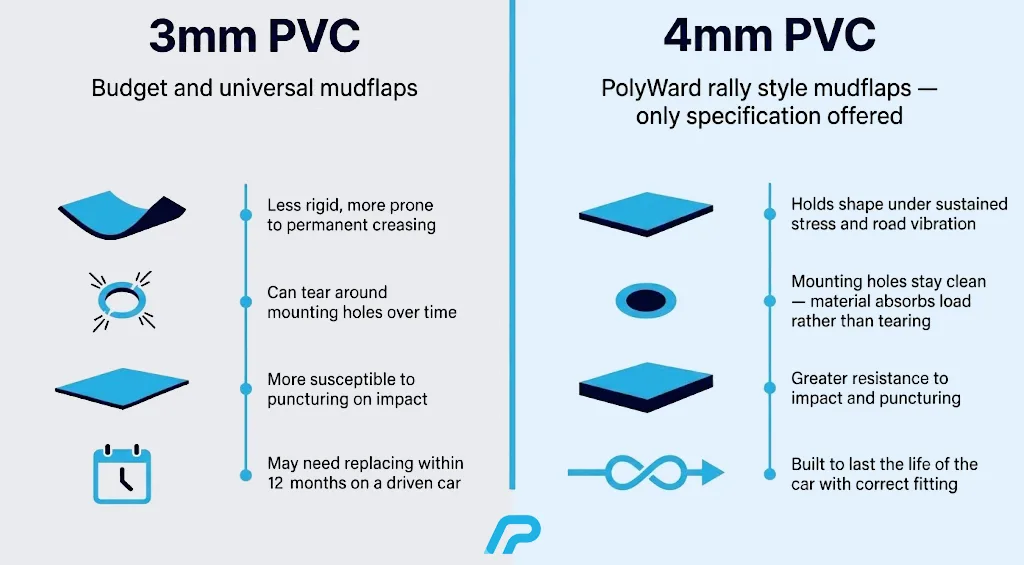
The 1mm difference in thickness between 3mm and 4mm PVC makes a more meaningful difference to longevity than it might appear.
4mm PVC holds its shape significantly better than 3mm under repeated stress. It’s harder to permanently crease or fold, and it resists puncturing more effectively. The most relevant difference for long-term durability is how the material behaves around mounting holes and slots under sustained load. With 3mm PVC, the material around a mounting hole can gradually tear over time as the fixing flexes with road vibration. With 4mm, the material holds the hole cleanly, and the stress is absorbed by the thickness of the sheet rather than propagating as a tear.
This is why PolyWard only uses 4mm PVC throughout the range with no thinner alternative. It’s the specification that holds up over years of road use rather than months.
For more on why the 4mm specification matters and what it adds to the cost of a precision-fit kit, see our post on why rally style mudflaps cost more.
Real-world experience
The Fiesta ST180 in Frozen White that appears in PolyWard’s product photography was owned and driven by us. That car had a set of PolyWard rally style mudflaps fitted for two years of daily and enthusiast driving, even going on track.
In that time, the mudflap material showed no degradation. The one maintenance task required was retightening a pair of hex bolts on the rear mudflaps after reversing up a particularly tall kerb at a car park. The kerb impact and drag on the mudflap put stress on the rear mounting hardware, and one bolt worked slightly loose. Spotted during a routine wash and retightened in two minutes. The mudflap itself was undamaged.
That’s representative of what to expect from a correctly fitted set on a driven car. The material lasts. The hardware needs an occasional check.
What to check and when
Mudflaps don’t require maintenance in the conventional sense. There’s no servicing schedule and no consumable parts. But a quick check at sensible intervals prevents the one failure mode that actually occurs in practice.
When washing the car: run a hand along each mudflap and check there’s no major movement at the mounting points. A properly fitted mudflap should be solid with very little or no flex at the fixing positions. Too much movement means a fixing has worked loose and needs retightening before it develops into a problem.
After any kerb contact: check the rear mudflaps specifically. Reversing over a kerb puts direct stress on the rear mounting hardware. A quick check immediately after is worth the 30 seconds.
After a brake job or wheel removal: usually the wheels need to come off for most brake service work. If anyone has been in the wheel arch area, check that the mudflap fixings and brackets are still tight afterwards.
What to avoid: There is nothing in normal car care that damages 4mm PVC. Wheel cleaner overspray, traffic film remover, snow foam, and pressure washing — none of these affects the material. The only products worth avoiding near the mounting hardware are aggressive penetrating lubricants that could affect the grip of clips and bolts. Standard car cleaning products are fine.
For what to expect when fitting rally style mudflaps, see the PolyWard rally style mudflap fitting guide.

What about generic or thin PVC mudflaps?
The longevity picture is different for generic hard plastic mudflaps and thinner PVC alternatives. Hard ABS plastic becomes brittle in cold weather and is prone to cracking on impact. A cold UK winter combined with a kerb strike is often enough to crack a hard plastic mudflap. Thin 3mm or 3.2mm PVC is more flexible than hard plastic but more susceptible to tearing around mounting holes under sustained load than 4mm.
A generic set that fails after 6-12 months costs the same if you have to rebuy and refit it, as a PolyWard set bought once. For more on the material comparison, see our post on hard plastic vs PVC rally style mudflaps.
Still weighing up whether rally style mudflaps are the right modification for your car? See our honest assessment of whether rally style mudflaps are worth it.
The short version
The mudflap material lasts. Check the fixings are tight when you wash the car. Retighten anything that’s worked loose after kerb contact. That’s the entire maintenance requirement for a set of properly fitted 4mm PVC rally style mudflaps.
See the full range of PolyWard rally style mudflaps — UK-made from 4mm PVC, vehicle-specific kits for the Ford Fiesta ST, Ford Focus ST225, Ford Focus ST250, Ford Focus RS Mk2, Seat Ibiza FR, Abarth 595 and 695, and Fiat 500. We provide same-day dispatch on orders placed before 3 pm.
Precision fit, UK made. Available for the following vehicles:


